Hello,
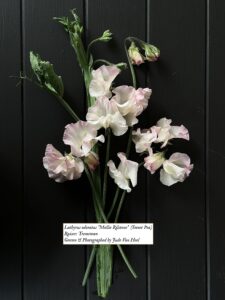
I’m starting a new Sweet Pea Q & A, answering questions I’m asked on Instagram and via email.
This way answers don’t get lost in the comment section and by sharing the answers it may help you too!
After all the world needs more sweet peas and if I can contribute to that all the better.
If you have a sweet pea question I’ll do my best to answer it in this new series otherwise I’ll direct you to websites I have found helpful.
Please be aware that I have very limited use of my hand (that includes typing) and have good and bad days with varying degrees of use. I have created a Sweet Pea page dedicated to these gorgeous blooms so please check the Sweet Pea page first to see if you can find your answer. To do this click on the SWEET PEA tab at the top of this page, 2nd from the right in between STUDIO and JOURNAL.
Question:
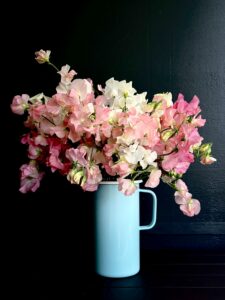
Your photos of Sweet Peas inspire me to try and grow different varieties. Lucky enough to buy these grown in Tasmania, but mine don’t look like they could be photographed. They are sparse in flowers with very short stems. I have very limited garden space, so I tried growing some in pots and hanging baskets, not with much luck. Would love to know what you can suggest. At least I can drool over your fabulous photos, which you have achieved using one hand. Thank you for lighting up my days.” Vivienne.
Answer:
I plant sweet pea seeds indoors in September. By mid October/early November they are young seedlings but past the fragile stage and are sturdy enough to be planted outside. By January/February they are 160-250cm tall and flowering abundantly. By March flowers have been pollinated and are developing into seed that can be collected for next season. That’s September to March, six months from planting seed to collecting seed, such a short growing season and the sweet peas are go, go, go from the minute the seeds are sown.
To do all that growing in such a short space of time sweet peas need A LOT of quality compost, manure, good air circulation to prevent mildew, sunshine, water, and their roots need to be able to grow down into the soil and the water needs to be able to soak down into that soil, only spraying the foliage isn’t enough. Take away or limit any of these necessities and that is the reason why your sweet peas are struggling.
Since this is a Sweet Pea Trial year for me I planted Little Sweet Heart Mix sweet peas in a large 50cm terracotta pot. I started the seeds myself and planted them into a good quality organic potting mix. All I have done is water them. No liquid seaweed or scattering dynamic lifter into the pot with the potting mix. The Sweet Peas are limping away, this variety should grow to 60cm tall but they are lucky to be 30cm with very few flowers. It was a good experiment to compare growing conditions/mediums.
Apart from growing conditions some sweet pea varieties do have smaller flowers and very short stems. Google is your best friend here and you can check the sweet pea variety you are interested in growing to see what its characteristics are before purchasing and planting seeds or seedlings.
If I was only able to plant sweet peas in pots and hanging baskets I wouldn’t bother with the hanging baskets for the above reasons. With regards to planting in pots I’d use a 50cm pot and add a mix of goodies to the organic potting mix, such as homemade compost or a shop bought equivalent, some well rotted manure, scatter a few hand fulls of dynamic lifter through the rich medium, use a liquid seaweed each week and add a thick layer of sugar cane mulch. Remembering to water deeply, regularly. Place the pot in full sun but it must be protected from the wind, you don’t want those establishing roots to be knocked around and disturbed by gusts of wind.
Sarah Raven (sarahraven.com) plants sweet peas in pots, her website is full of gardening information and she also has a Youtube channel.
Love from the Garden,
Jude x
Sweet Pea Q & A. #2. Growing Sweet Peas in Pots and Hanging Baskets.
February 18, 2026

comments
share